
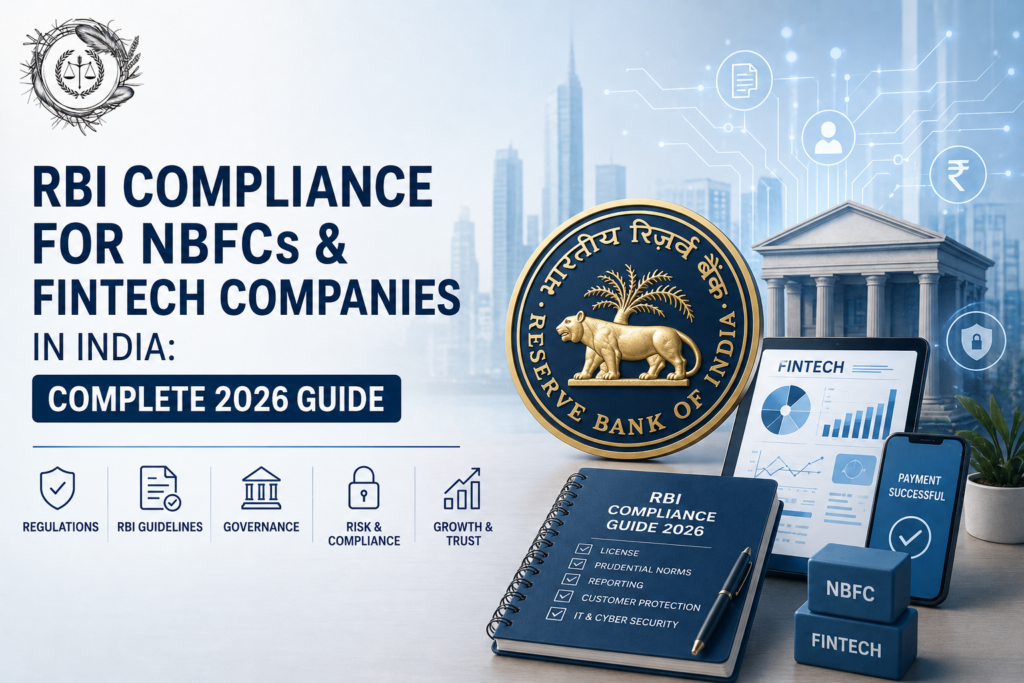
RBI Compliance for NBFCs & Fintech Companies in India
If you’re running an NBFC, fintech startup, lending platform, payment business, or even a fast-scaling BFSI company in India right now, there’s one thing you simply cannot afford to ignore in 2026 — RBI compliance for NBFCs.
And honestly, most founders in Mumbai realise this only after they receive an RBI notice, an audit observation, a payment gateway restriction, or a legal due diligence query from investors.
Over the last few years, RBI scrutiny around digital lending, KYC failures, outsourcing models, AI-driven financial products, and customer grievance handling has increased massively. What looked like “operational flexibility” in 2022 is now becoming a direct compliance risk in 2026.
A lot of fintech founders still think compliance is only about filing returns. It’s not. In reality, RBI compliance today touches product design, vendor contracts, onboarding flows, AI systems, customer communication, lending practices, data storage, and even your marketing language.
Complete RBI Compliance Checklist for Fintech Startups in India
Most fintech startups in Mumbai begin with speed. Growth first. Compliance later.
That works for a while. Until investors, payment partners, or regulators start asking difficult questions.
A practical fintech compliance framework in India usually includes:
1. KYC & Customer Verification Compliance
Every fintech handling customer onboarding must carefully follow KYC norms India requirements.
This includes:
- Aadhaar-based verification rules
- CKYC integration
- Video KYC requirements
- Risk categorisation
- PEP screening
- Ongoing customer monitoring
One common issue we see with startups is outsourced onboarding vendors cutting corners just to improve conversion rates. Founders often don’t even realise their onboarding journey violates RBI expectations until a compliance audit happens.
And yes, RBI takes KYC lapses seriously now.
2. AML Compliance Obligations
AML compliance is no longer relevant only for large banks.
NBFCs, digital lenders, payment businesses, and fintech aggregators are increasingly expected to maintain:
- suspicious transaction reporting systems
- transaction monitoring frameworks
- escalation protocols
- employee compliance training
- record retention systems
Many early-stage founders underestimate how expensive AML infrastructure becomes later if not designed correctly from day one.
In Mumbai especially, where fintech partnerships move fast, transaction volumes scale rapidly. Compliance systems often fail before business teams even notice the operational risk.
3. FEMA Compliance Risks
A surprising number of fintech startups unintentionally create FEMA compliance exposure while:
- receiving foreign investment
- using overseas SaaS vendors
- processing international payments
- issuing ESOPs to foreign employees
- integrating cross-border APIs
This is where an experienced corporate lawyer in Mumbai or a specialised RBI legal advisor becomes critical.
Because FEMA violations may not create immediate problems. But during funding rounds or acquisitions, these issues suddenly become very visible.
4. Vendor & Outsourcing Risk Management
One major area RBI is watching closely is outsourcing.
A fintech cannot simply say:
“The vendor handled it.”
Regulators increasingly expect accountability from the regulated entity itself.
Important areas include:
- cloud agreements
- data processing contracts
- customer support outsourcing
- collection agencies
- KYC vendors
- AI-based underwriting tools
A strong vendor agreement today is not just commercial documentation. It’s part of your compliance shield.
Legal & Regulatory Compliance for NBFCs in India
For NBFCs, compliance obligations are broader and significantly more operational than many founders expect.
An NBFC is not just a “licensed business.” It is a continuously regulated business.
That distinction matters.
Core NBFC Compliance Areas
Most NBFC compliance frameworks include:
- RBI filings
- prudential norms
- fair practices code
- board reporting
- statutory audits
- internal audits
- cybersecurity compliance
- grievance redressal systems
- loan recovery protocols
- regulatory disclosures
And in 2026, RBI expectations around governance are clearly becoming stricter.
The Real Cost of Non-Compliance
A lot of businesses only calculate:
- legal consultation fees
- filing costs
- compliance software costs
But the actual financial impact of poor compliance is much larger.
For example:
- delayed funding rounds
- frozen partnerships
- payment disruptions
- reputational damage
- customer litigation
- regulatory penalties
- investor distrust
Sometimes one badly drafted digital lending agreement creates bigger losses than an entire year’s compliance budget.
Mumbai-Specific Compliance Reality
Mumbai-based fintech businesses operate in an extremely aggressive ecosystem.
Founders here move fast. Partnerships happen quickly. Products launch rapidly.
But RBI expectations don’t slow down just because a startup is scaling.
We’ve seen businesses with:
- brilliant tech
- strong funding
- great user traction
…still struggle because their legal structure and compliance documentation were weak.
This is exactly why many businesses now engage a dedicated business lawyer in Mumbai or a specialised corporate law firm in Mumbai much earlier in the growth cycle instead of waiting for regulatory trouble.
How Fintech Companies Can Stay RBI Compliant in 2026
The smartest fintech founders in 2026 are no longer treating compliance as a “legal department issue.”
They’re integrating compliance into operations itself.
That’s the real shift happening.
Practical Steps Fintech Companies Should Take
Build Compliance During Product Development
Before launching:
- BNPL products
- co-lending models
- AI underwriting
- wallet systems
- embedded finance products
…legal review should happen early.
Fixing compliance later is always more expensive.
Conduct Quarterly Compliance Reviews
A quarterly review should ideally cover:
- KYC failures
- grievance complaints
- vendor risks
- data privacy exposure
- RBI circular updates
- lending disclosures
- collection practices
Many founders assume annual audits are enough. They’re usually not.
Maintain Proper Documentation
This sounds basic, but it becomes critical during RBI inspections.
Keep organised:
- board resolutions
- policy documents
- outsourcing agreements
- customer disclosures
- consent records
- grievance reports
- compliance certifications
In many RBI reviews, poor documentation itself becomes a red flag.
Train Teams Properly
One practical issue we constantly observe:
Operations teams often create the biggest compliance risks unknowingly.
For example:
- aggressive recovery language
- misleading sales scripts
- incorrect customer promises
- unauthorised data sharing
Regular compliance training is becoming non-negotiable for fintech businesses.
Digital Lending & RBI Compliance Laws Explained
Digital lending is probably the most heavily scrutinised fintech segment in India right now.
And honestly, for good reason.
Over the last few years, RBI has cracked down on:
- hidden charges
- unethical recovery methods
- fake lending apps
- unauthorised data collection
- non-transparent loan structures
Key Digital Lending Compliance Areas
Transparent Loan Disclosure
Borrowers must clearly understand:
- interest rates
- processing fees
- penalties
- repayment schedules
- foreclosure terms
Hidden charges are a major regulatory trigger.
Customer Consent Requirements
Apps collecting:
- contact lists
- location data
- SMS access
- device permissions
…without proper consent create serious legal exposure.
This overlaps not just with RBI compliance India requirements but also broader data privacy concerns.
Recovery & Collection Compliance
Recovery-related complaints are growing rapidly.
Even outsourced recovery agents can create direct regulatory risk for fintech companies.
Founders should regularly review:
- call recordings
- WhatsApp communication
- escalation methods
- field recovery practices
One viral customer complaint today can damage years of brand building.
RBI Regulations Every Fintech Founder Must Know
Some RBI regulations are repeatedly ignored by startups until problems arise.
Here are a few areas founders should pay serious attention to:
Fair Practices Code
Every lending business should maintain transparent and ethical customer treatment standards.
This is not just policy paperwork. RBI expects practical implementation.
Cybersecurity & Data Storage
Cyber incidents in BFSI businesses are increasing.
Fintech companies should have:
- cybersecurity policies
- incident response systems
- vendor security reviews
- access control mechanisms
- backup systems
A data leak today creates:
- legal risk
- customer distrust
- investor concern
- regulatory exposure
All at the same time.
Grievance Redressal Mechanism
Many startups underestimate customer complaint management.
RBI increasingly expects:
- response timelines
- escalation frameworks
- nodal officers
- complaint tracking systems
Ignoring complaints can eventually become a compliance issue itself.
AI Laws in India: What Every Business Must Know in 2026
Now this is where things are getting even more interesting.
AI adoption inside fintech and NBFC operations has exploded.
Businesses are using AI for:
- underwriting
- fraud detection
- chatbot support
- collection analytics
- customer profiling
- predictive risk assessment
But Indian businesses are entering risky territory when AI decisions directly affect customers.
Legal Risks of Using AI for Indian Companies
A lot of founders assume AI tools automatically reduce compliance risk.
That’s not always true.
AI systems can create:
- biased lending decisions
- inaccurate customer profiling
- discriminatory outcomes
- privacy violations
- data misuse exposure
For regulated industries like BFSI, these risks become even more serious.
This is why many businesses now seek:
- corporate AI legal advisory
- AI governance frameworks
- AI policy drafting
- AI vendor compliance reviews
Especially when third-party AI systems are involved.
AI Compliance Checklist for Startups & Enterprises
If your business uses AI in customer-facing financial operations, consider the following:
AI Compliance Essentials
- Maintain human oversight
- Document AI decision logic
- Conduct bias testing
- Review AI vendor agreements
- Obtain customer consent where required
- Maintain audit trails
- Protect sensitive financial data
- Avoid misleading AI-generated financial recommendations
The companies that proactively manage AI governance today will likely avoid major regulatory headaches later.
Practical Founder-Level Reality About RBI Compliance
Let’s be honest.
Most startup founders don’t ignore compliance because they don’t care.
They ignore it because:
- growth pressure is intense
- funding expectations are aggressive
- operational teams are stretched
- compliance feels “non-revenue generating”
But in India’s regulated financial ecosystem, compliance eventually becomes a growth enabler itself.
Investors care about it.
Enterprise partners care about it.
Banks care about it.
And RBI definitely cares about it.
FAQs on RBI Compliance for NBFCs & Fintech Companies
Do fintech startups need RBI approval in India?
It depends on the business model. Some fintech companies operate as technology providers, while others require NBFC partnerships or direct RBI licensing depending on lending, payment, or financial activities.
What happens if an NBFC violates RBI compliance rules?
Possible consequences include:
- penalties
- operational restrictions
- licence-related action
- audit investigations
- reputational damage
- investor concerns
In serious cases, RBI intervention can significantly affect business continuity.
How much does NBFC compliance usually cost in India?
Compliance costs vary widely depending on:
- transaction volume
- operational scale
- product structure
- technology infrastructure
- legal advisory requirements
For many growing fintech companies, compliance becomes a recurring operational investment rather than a one-time legal expense.
Can outsourced vendors create RBI compliance risk?
Absolutely. RBI increasingly expects regulated entities to remain accountable even when activities are outsourced.
Vendor agreements, monitoring systems, and audit rights are extremely important now.
Why are fintech founders in Mumbai increasingly hiring specialised corporate law firms?
Because fintech regulation has become highly specialised.
General legal support is often not enough for:
- RBI regulations for fintech
- digital lending compliance
- FEMA structuring
- AI compliance
- investor due diligence
- regulatory audits
Businesses increasingly prefer experienced corporate law firm in Mumbai teams that understand both legal and operational realities.
Is AI regulation relevant for NBFCs already?
Yes. Especially if AI affects:
- customer profiling
- lending decisions
- fraud detection
- automated communication
- creditworthiness analysis
AI governance is quickly becoming part of broader fintech compliance India discussions.
Final Thoughts
In 2026, RBI compliance is no longer just about avoiding penalties. It’s about building a financially sustainable, investable, and trustworthy business.
The Indian fintech ecosystem is maturing rapidly. Regulators are evolving. Customer awareness is increasing. Investors are asking sharper questions.
And honestly, businesses that build compliance early usually scale more smoothly later.
Because once a company enters regulatory trouble, fixing the damage becomes significantly harder than preventing it in the first place.