
Commercial Dispute Resolution in India: Arbitration vs Litigation for Businesses
A delayed payment. A broken shareholder promise. A vendor suddenly backing out after taking advance money. Or worse — a co-founder dispute right when the business starts scaling.
Most businesses in Mumbai and Delhi don’t realise how expensive commercial disputes become until legal notices start flying across inboxes and operations begin slowing down internally. What usually starts as a “manageable disagreement” quickly turns into financial pressure, reputational damage, investor anxiety, and management distraction.
Over the last few years, commercial dispute resolution in India has become one of the most critical areas for businesses — especially startups, SMEs, NBFCs, manufacturing companies, and founder-led enterprises. And one question almost every business owner eventually asks is:
Should we go for arbitration or litigation?
The answer is rarely black and white. It depends on the contract structure, urgency, business relationships, enforceability concerns, cost implications, and long-term commercial strategy.
This guide explains arbitration vs litigation in India from a practical business perspective — not from a textbook angle.
What is Commercial Dispute Resolution?
Commercial dispute resolution in India refers to the legal process used to resolve business-related conflicts between companies, founders, investors, vendors, partners, shareholders, clients, or financial institutions.
These disputes usually involve:
- Contract breaches
- Payment recovery issues
- Shareholder disagreements
- Partnership conflicts
- Vendor disputes
- Intellectual property disagreements
- Debt recovery claims
- NCLT litigation
- Insolvency disputes
- Cross-border commercial conflicts
In real business situations, disputes are rarely only “legal.” They are commercial, emotional, operational, and financial at the same time.
A founder in Mumbai once explained a shareholder dispute perfectly during a consultation:
“The legal issue is one thing. But the bigger issue is that my business is frozen while the dispute continues.”
That is exactly why businesses today look beyond traditional litigation and increasingly explore ADR services India offers, including arbitration and mediation.
Commercial Litigation in India: Legal Remedies for Businesses & Startups
Commercial litigation India has evolved significantly after the introduction of Commercial Courts under the Commercial Courts Act.
Businesses now approach courts for:
- Injunctions
- Contract enforcement
- Recovery suits
- Shareholder oppression claims
- Insolvency proceedings
- Intellectual property disputes
- Fraud allegations
- Partnership dissolution matters
However, litigation still comes with practical business concerns:
- Long timelines
- Procedural complexity
- Multiple hearings
- Operational distractions
- Public exposure of disputes
- Rising legal costs
For startups and SMEs, prolonged litigation can seriously impact cash flow and investor confidence.
This is where businesses start evaluating arbitration vs litigation more strategically.
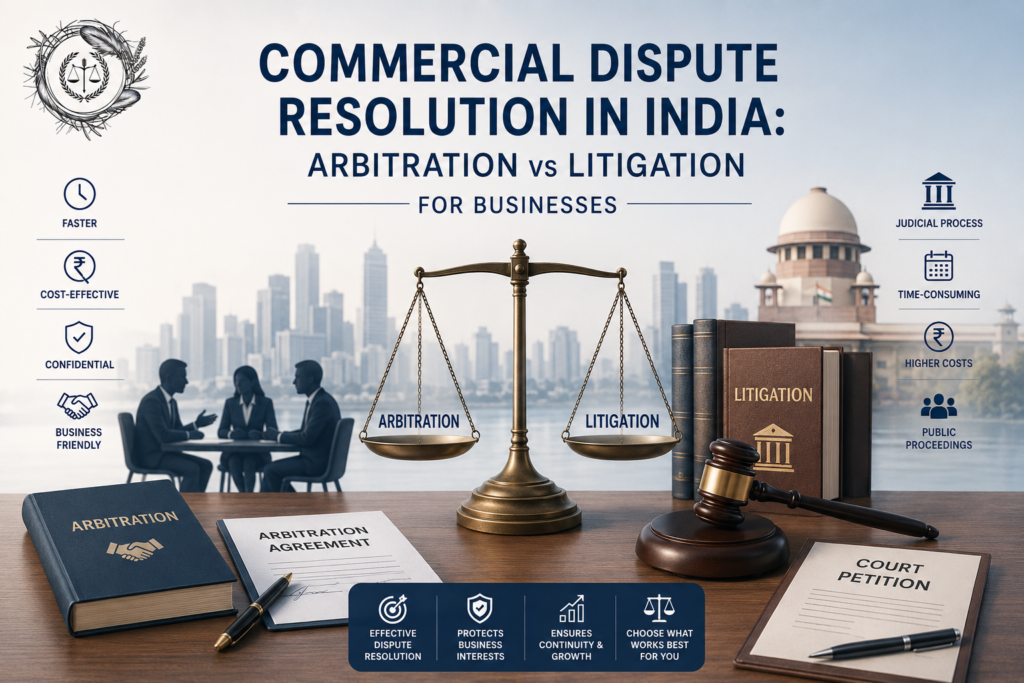
Arbitration vs Litigation in India
This is probably the most important decision businesses make while resolving disputes.
Arbitration
Arbitration is a private dispute resolution mechanism where parties appoint an arbitrator instead of approaching a traditional court.
Litigation
Litigation involves resolving disputes through courts and judicial processes.
Here’s the practical business difference.
| Factor | Arbitration | Litigation |
|---|---|---|
| Privacy | Confidential | Public |
| Speed | Faster in many cases | Often slower |
| Flexibility | High | Procedural |
| Appeal Scope | Limited | Wider |
| Enforcement | Strong under Arbitration Act | Court decree enforcement |
| Cost | Can become expensive in high-value matters | Court fees lower initially |
| Relationship Preservation | Better | Usually adversarial |
Businesses in sectors like fintech, manufacturing, SaaS, logistics, healthcare, and infrastructure increasingly prefer arbitration agreements India recognizes legally because they provide more commercial flexibility.
But arbitration is not always the better option.
And that’s something many businesses realise too late.
Understanding Commercial Arbitration Laws in India (2026 Guide)
Commercial arbitration in India is primarily governed by the Arbitration and Conciliation Act, 1996.
India has become significantly more arbitration-friendly in recent years, especially for commercial and cross-border disputes.
The law supports:
- Domestic arbitration
- International commercial arbitration
- Interim reliefs
- Enforcement of arbitral awards
- Emergency arbitration principles
- Institutional arbitration
Courts today generally encourage businesses to honour arbitration clauses in commercial contracts.
That said, poorly drafted arbitration agreements create massive practical issues.
A badly written arbitration clause can lead to disputes over:
- Arbitrator appointment
- Seat of arbitration
- Jurisdiction
- Governing law
- Language
- Costs
- Enforcement rights
And suddenly the business ends up litigating the arbitration itself.
This happens more often than people think.
Commercial Arbitration in India: Everything Businesses Need to Know
Commercial arbitration works particularly well in situations involving:
- High-value contracts
- Shareholder agreements
- Vendor agreements
- Infrastructure contracts
- Construction disputes
- Cross-border transactions
- Technology licensing
- Joint ventures
Businesses prefer arbitration because:
- Proceedings stay confidential
- Hearings are more flexible
- Technical expertise matters
- Court formalities reduce
- Resolution may happen faster
For enterprise businesses and investors, confidentiality alone becomes a major reason.
No company wants sensitive financial or shareholder information publicly discussed during litigation.
Benefits of Arbitration for Businesses
1. Confidentiality
This is extremely important for startups, investor-backed companies, and large enterprises.
Court proceedings become public records. Arbitration generally remains private.
2. Commercial Flexibility
Parties can structure procedures more efficiently.
3. Better for Cross-Border Deals
International businesses often prefer arbitration over Indian court litigation.
4. Specialist Arbitrators
In technical disputes, parties can appoint industry-aware arbitrators.
5. Reduced Procedural Delays
Not always fast — but often faster than prolonged commercial litigation India experiences.
Arbitration Clauses in Commercial Contracts: Why They Matter
Most businesses ignore dispute resolution clauses while signing agreements.
That is a costly mistake.
An arbitration clause should clearly define:
- Seat of arbitration
- Governing law
- Number of arbitrators
- Jurisdiction
- Language
- Institutional or ad-hoc arbitration
- Interim relief rights
A weak arbitration clause creates unnecessary future litigation.
Experienced corporate law firms in Mumbai usually review these clauses very carefully in investor agreements, franchise agreements, vendor contracts, and shareholder documents.
When Litigation Becomes Necessary
Despite the popularity of arbitration law India follows today, litigation still becomes unavoidable in many situations.
Litigation becomes important when:
- Fraud allegations exist
- Criminal elements are involved
- Urgent injunctions are needed
- Public law issues arise
- Third-party rights are involved
- Arbitration clauses are absent
- Insolvency proceedings begin
- Regulatory authorities become involved
Many business owners assume arbitration solves everything.
It does not.
In several cases, litigation strategy becomes commercially stronger than arbitration.
Especially where aggressive recovery actions or interim court protections are required.
Commercial Court Litigation in India: Process, Laws & Legal Remedies
Commercial courts India introduced have improved business litigation considerably.
These courts specifically handle high-value commercial disputes.
Commercial courts generally deal with:
- Banking disputes
- Shareholder disputes
- Infrastructure claims
- Franchise conflicts
- Contract breaches
- Trade disputes
- Recovery suits
For businesses, commercial courts provide:
- Faster procedural timelines
- Structured case management
- Commercially specialised judicial handling
But practical delays still exist depending on jurisdiction and case complexity.
Mumbai and Delhi commercial courts remain heavily active because of the volume of business disputes.
Role of Commercial Courts in India
Commercial courts play a major role in:
- Interim injunctions
- Recovery actions
- Contract enforcement
- Intellectual property litigation
- Arbitration-related court proceedings
- Enforcement actions
For many businesses, commercial courts become strategically important even alongside arbitration.
For example:
- Seeking interim relief before arbitration
- Enforcing arbitral awards
- Challenging arbitration awards
- Preventing asset diversion
Mediation & Alternative Dispute Resolution (ADR)
One major shift happening in India is the growing use of mediation for commercial disputes.
And honestly, many business disputes should never reach full litigation.
Good mediation can save:
- Business relationships
- Legal expenses
- Management time
- Brand reputation
- Investor confidence
ADR services India now include:
- Arbitration
- Mediation
- Conciliation
- Negotiated settlements
Commercially mature businesses increasingly use mediation before escalation.
Alternative Dispute Resolution (ADR) in India: Arbitration, Mediation & Conciliation Explained
Arbitration
Binding legal resolution through arbitrators.
Mediation
Neutral facilitator helps parties settle voluntarily.
Conciliation
More interventionist settlement process.
For founder disputes and partnership conflicts, mediation often works surprisingly well when emotions are controlled early.
The problem is businesses usually approach lawyers after relationships completely collapse.
By then, litigation becomes inevitable.
Mediation vs Arbitration in India: Best Dispute Resolution Strategy for Businesses
Mediation Works Better When:
- Parties want future business continuity
- Reputation management matters
- Settlement flexibility is needed
Arbitration Works Better When:
- Contracts are detailed
- Monetary disputes are large
- Binding enforceable outcomes are required
Commercial strategy matters more than ego here.
Unfortunately, many disputes escalate because founders take legal positions emotionally instead of commercially.
Common Commercial Disputes Businesses Face
Corporate Litigation in India: Common Business Disputes & Legal Remedies
Some of the most common disputes businesses face include:
Contract Disputes
- Delayed performance
- Payment defaults
- Vendor breaches
- Service failures
Shareholder Disputes
- Equity dilution conflicts
- Founder exits
- Voting rights issues
Partnership Conflicts
- Profit-sharing disagreements
- Operational disputes
- Mismanagement allegations
Debt Recovery Disputes
- Outstanding receivables
- Supplier defaults
- Financial recovery actions
Insolvency Disputes
- NCLT proceedings
- CIRP matters
- Creditor claims
Cross-Border Disputes
- International supply contracts
- Foreign investor conflicts
- Enforcement complications
Contract Disputes in India: Legal Solutions for Businesses
Contract disputes are probably the most common business disputes in India.
Most commercial litigation begins because contracts are:
- Poorly drafted
- Ambiguous
- Copied from templates
- Legally inconsistent
A business lawyer in Mumbai will usually first examine:
- Termination clauses
- Liability limitations
- Jurisdiction clauses
- Arbitration clauses
- Payment obligations
Good contracts prevent future litigation.
Bad contracts create future litigation.
Simple.
Legal Remedies for Breach of Contract in India
Businesses may seek:
- Specific performance
- Damages
- Injunctions
- Recovery claims
- Termination rights
- Arbitration remedies
But legal rights alone are not enough.
Enforcement practicality matters equally.
Sometimes the best commercial solution is settlement — not courtroom victory.
Shareholder & Partnership Disputes in India: Legal Remedies Explained
Founder and shareholder disputes become deeply personal very quickly.
Especially in startups.
Common triggers include:
- Unequal effort contribution
- Equity dilution
- Investor pressure
- Financial transparency issues
- Exit disagreements
Many businesses in Delhi and Mumbai approach dispute resolution lawyers only after internal communication completely breaks down.
At that stage, legal strategy must also consider:
- Reputation
- Investor confidence
- Team morale
- Operational continuity
NCLT Litigation & Insolvency Disputes in India Explained
NCLT litigation has increased sharply in India.
Businesses now regularly face:
- Insolvency applications
- Operational creditor disputes
- Financial creditor actions
- Oppression and mismanagement claims
For companies already under financial stress, insolvency-related disputes can become extremely aggressive.
Speed and legal positioning matter enormously here.
Debt Recovery & Commercial Litigation Services in India
Debt recovery is no longer just a legal issue.
It is a business survival issue.
Especially for:
- SMEs
- Manufacturers
- Service providers
- NBFCs
- Logistics businesses
Delayed recoveries damage working capital cycles heavily.
A commercially experienced business litigation law firm usually focuses on:
- Negotiated recoveries
- Strategic legal notices
- Commercial settlements
- Recovery suits
- Insolvency leverage where appropriate
Cross-Border Commercial Disputes
Cross-Border Commercial Disputes
Cross-border disputes require significantly more strategic planning.
These matters usually involve:
- Foreign governing laws
- International arbitration
- Jurisdiction conflicts
- Enforcement challenges
- Multi-country evidence issues
International businesses often prefer arbitration because enforcing arbitral awards internationally becomes easier under the New York Convention framework.
Enforcement of Arbitral Awards in India: Legal Process Explained
Winning arbitration does not automatically guarantee payment.
Enforcement still matters.
Indian courts generally support enforcement unless:
- Public policy issues arise
- Procedural unfairness exists
- Jurisdictional defects appear
Businesses should evaluate enforceability before initiating arbitration itself.
A legally strong award against a financially weak entity may still create commercial frustration.
Business Dispute Resolution in India: Legal Strategies to Avoid Costly Litigation
Smart businesses reduce disputes proactively.
Some practical strategies include:
- Strong contract drafting
- Clear shareholder agreements
- Defined payment schedules
- Proper compliance systems
- Early legal consultation
- Internal dispute escalation frameworks
- Regular legal audits
The cost of prevention is usually far lower than the cost of litigation.
How Businesses Can Resolve Commercial Disputes in India
Commercial dispute resolution India businesses require today is not just about legal aggression.
It is about:
- Commercial practicality
- Speed
- Negotiation leverage
- Business continuity
- Risk management
Every dispute requires a different approach.
Sometimes aggressive litigation works.
Sometimes quiet mediation works better.
Sometimes arbitration protects confidentiality.
And sometimes the smartest strategy is settlement before escalation.
How Businesses Can Reduce Litigation Risks
Businesses should:
- Review contracts annually
- Avoid vague commercial commitments
- Document negotiations properly
- Maintain written approvals
- Use structured legal compliance systems
- Engage corporate legal advisors early
One overlooked email can become major litigation evidence later.
That happens regularly in commercial disputes.
Litigation Services for Businesses in India: A Complete Legal Guide
A professional corporate law firm in Mumbai or Delhi generally assists businesses with:
- Contract enforcement
- Arbitration proceedings
- Commercial court litigation
- Debt recovery
- NCLT matters
- Shareholder disputes
- Mediation
- Cross-border dispute strategy
Businesses increasingly prefer long-term legal advisory relationships rather than reactive litigation handling.
And honestly, that approach saves far more money over time.
How a Law Firm Can Help in Commercial Disputes
An experienced dispute resolution lawyer does much more than filing cases.
Good commercial legal advisors help businesses:
- Prevent disputes
- Negotiate settlements
- Protect commercial interests
- Structure contracts properly
- Preserve investor confidence
- Reduce operational damage
The best legal strategy is usually commercially intelligent — not emotionally aggressive.
FAQs
Is arbitration better than litigation for businesses in India?
It depends on the dispute type, contract structure, urgency, and enforcement concerns. Arbitration is often faster and confidential, but litigation may become necessary in fraud, insolvency, or urgent injunction matters.
How expensive is commercial arbitration in India?
Arbitration costs vary significantly depending on claim size, arbitrator fees, institutional involvement, and hearing complexity. High-value arbitration can become expensive, especially with senior arbitrators.
Can startups use mediation before litigation?
Absolutely. In fact, mediation often helps startups preserve investor confidence and avoid unnecessary operational disruption.
Are arbitral awards enforceable in India?
Yes. Indian courts generally support enforcement of arbitral awards unless major procedural or public policy concerns exist.
What are the biggest causes of shareholder disputes in startups?
Equity dilution, founder exits, voting rights conflicts, financial transparency concerns, and operational control disagreements are common triggers.
How long does commercial litigation take in India?
There is no fixed timeline. Commercial courts have improved timelines, but complex matters can still take considerable time depending on jurisdiction and procedural developments.
Should every business contract include an arbitration clause?
Not necessarily every contract, but most significant commercial agreements should carefully evaluate dispute resolution clauses.
Can businesses recover unpaid invoices legally in India?
Yes. Businesses can pursue recovery through legal notices, commercial suits, arbitration, or insolvency proceedings depending on the situation.
Conclusion
Commercial disputes are now an unavoidable reality of doing business in India.
Whether it is a startup founder conflict in Delhi, a vendor payment dispute in Mumbai, an NBFC recovery issue, or a cross-border contractual disagreement — businesses need commercially practical legal strategies, not just aggressive courtroom battles.
The debate around arbitration vs litigation is ultimately about business priorities:
- Speed
- Confidentiality
- Cost
- Enforceability
- Commercial relationships
- Long-term operational impact
And the smartest businesses are no longer waiting for disputes to explode before involving legal advisors.
They are building legally stronger businesses from the beginning.
Because in commercial reality, prevention is always cheaper than prolonged litigation.